Developments in Harm Reduction – the DRNS Annual Conference 2026

Developments in Harm Reduction – the DRNS Annual Conference 2026
In this blog, Medical Student Isobel Tindle summarises and reflects on attending the DRNS Annual Conference.
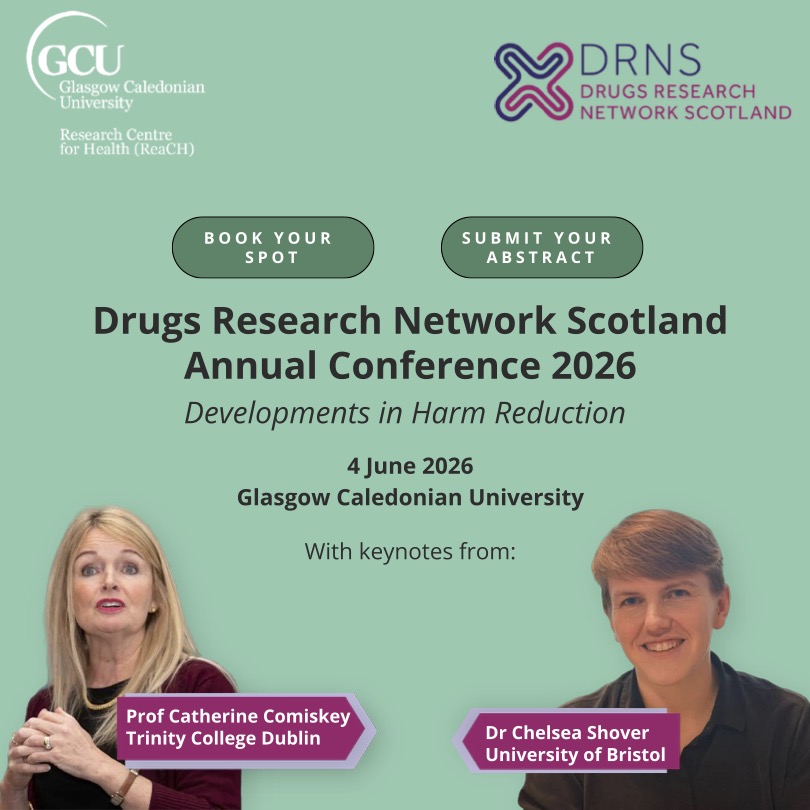
On the 4th June 2026, DRNS hosted its annual conference at Glasgow Caledonian University. The day focussed on knowledge exchange and provided an opportunity for academic researchers, practitioners and clinicians, third sector representatives, and people with living/lived experience to hear and share research. The conference theme focused on developments in harm reduction, covering a wide range of topics. Submissions also included priority areas identified by the DRNS membership; i) harms and drug-related deaths, ii) treatment and recovery, iii) legal changes, and iv) drugs as medicines.
From LA to Dublin – the 2026 Keynote Speakers
Dr Chelsea Shover opened the conference with a presentation on community drug testing as not only a harm reduction technique, but also as a means of gathering data for vital research. Dr Shover presented research from working at Community Health Project LA (CHPLA); a third-sector organisation in Los Angeles (LA), California, USA. The research explored the purity, dosing, and cutting of numerous different drugs available in LA. Key findings of the study included the wide range of purity of drugs tested – even those acquired on the same day from the same block.
Professor Catherine Comiskey later closed the conference with a keynote presentation on findings from another harm reduction project; the Republic of Ireland's first medically-supervised injection facility (MSIF) in Dublin. Strong political pushback to the MSIF's opening revolved around its proximity to a primary school, but a study undertaken into the impact to the local community showed that it hadpositively affected the community. The study findings emphasised how the MSIF did not harm the nearby primary school located a five-minutes' walk away; rather, it improved various safety metrics for the neighbourhood that the MSIF opened in.
Vibrance and topic diversity – parallel and poster sessions
Parallel Sessions
In addition to the keynotes, the conference was packed with presentations and posters covering key central themes; i) Monitoring Drug- Related Harms in Scotland, ii) Women's experiences of substance use and care, iii) From data to drug deaths: What evidence tells us, iv) Gaps, innovations and the evolving treatment landscape. A full list of the presentations can be found here.
- The poster session showcased the vibrant drugs research community in Scotland. DRNS were excited to award Megan Glancy, from GCU, with the Best Poster Award for the study Drug-related death rates associated with prescribed and illicit benzodiazepine exposure among people receiving opioid-agonist treatment in Scotland, 2011 to 2020.
Let's talk about ketamine
In recent years, ketamine has been a key focus of discussion which was highlighted this year with the publication of the Advisory Council on the Misuse of Drugs 's review of use and harms. With such a focus on ketamine, it was vital to further expand on discussions which was the topic of the afternoon panel session.
During this session, Dr Kristin E. Ceniccola-Campos and Laura Murphy presented findings from a rapid evidence review of ketamine availability in Scotland, based on police seizure data, and potential testing methods for harm reduction. They later joined Sarah Peat (Crew 2000) and Thomas Delaney (Speaker & Educator and Founder of YouthWISE) for a panel discussion which discussed trends and barriers to treatment.
Remembering the people we have lost
As always in this field, we acknowledge the toll drug-related deaths and drug-related harm has on our communities. The day finished with a Moment of Remembrance – an opportunity to reflect and remember the far too many lives lost too soon in Scotland.